
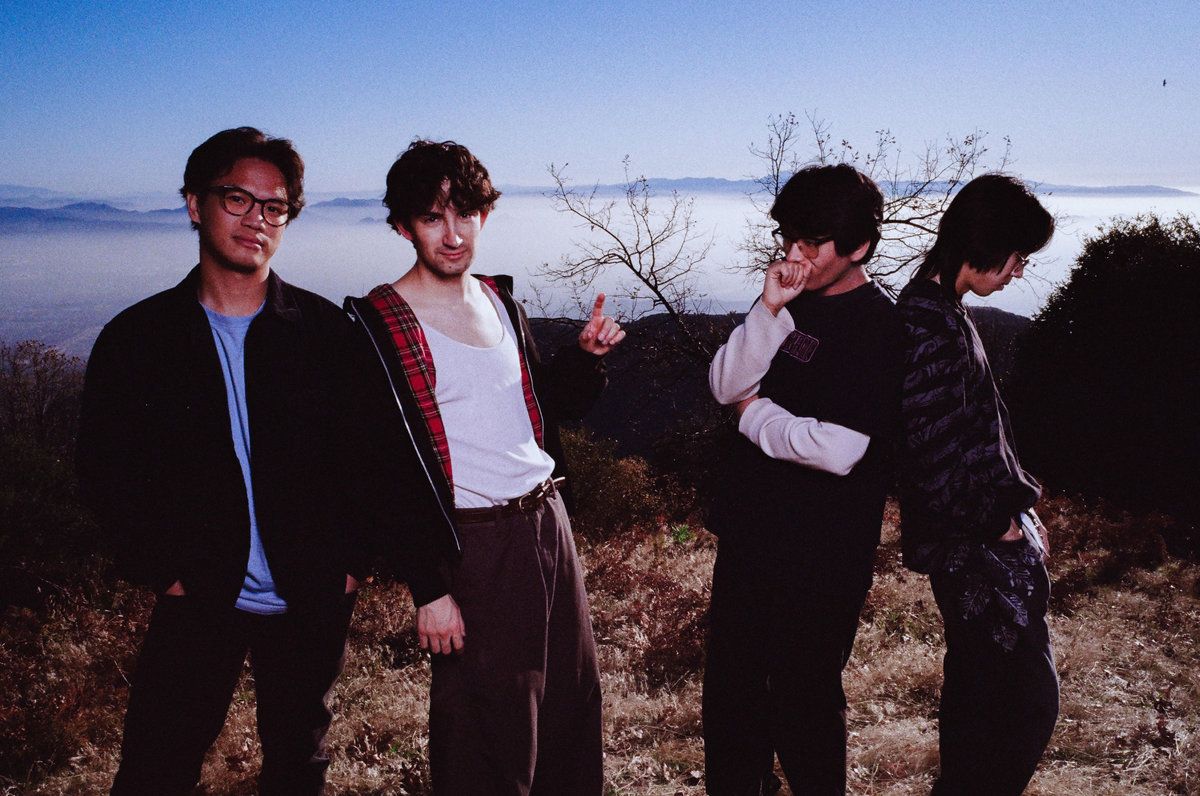
KSDT: We're here at KSDT Radio with SoCal’s very own Driftwould. Can you guys give us your names and what you play in the band?
Luke: I'm Luke, and I mainly play bass.
Bruin: I'm Bruin. I play drums.
Nathan: I'm Nathan. I'm one of the guitarists.
Guy: I’m Guy. I sing and play guitar.
KSDT: With the release of records like American Football's LP 4, A$AP Rocky’s Don't Be Dumb, and, of course, The Bridge. 2026 has been a very stacked year for music. What have each been listening to as of late, and if any, what are your favorite releases of the year so far?
Guy: Meat computer, I've been listening to a lot of Visible Cloaks, and Toe’s Now I See The Light I've been blasting that on repeat.
Luke: I like the new Sweet Pill album, Still There’s a Glow. I’ve also been listening to Nouns, if you know them, and then Vildjartha.
Bruin: I recently got into Prurient, so Rainbow Mirror has been on repeat for me.
Nathan: There’s this artist, Dani Offline, I saw her at SF Jazz a couple of months back. She’s like this RNB Jazz singer and producer; she’s awesome. And not 2026, I’m still bumping The Art of Loving by Olivia Dean, my favorite artist.
Luke: The homies in Citrus Jr. just dropped an album. I’ve only heard it live, but I know it slaps.
KSDT: When we last spoke to y’all we got the chance to discuss your debut release Driftwould, in the time since then, you’ve released the bridge, a noticeably darker and more textural evolution of the sound you explored on your self-titled record. Over the past year and a half, what has changed within driftwould, either creatively or personally, that pushed the album in that direction?
Guy: When we made the first album, we hadn't actually played many gigs yet. So at the time, we focused more on just putting our own vision together. But in the time since we’ve started actually performing it, and playing alongside local emo bands like Citrus Junior, Echinacea, now known as Caspia, and Transmutation.
So all in all, I’d say the biggest influence was just trying to see how we could contribute our voice to this scene. We were so inspired by their sets and their energy that we just wanted to have a piece of that.
Luke: On my end, I’d say I got more confident as a songwriter to really say what I mean and not beat around the bush. To talk about shit that really affected me emotionally. In the past, I think I was writing too intellectually, trying to create what I thought a song should be instead of writing songs that I want to hear and want to feel.
KSDT: In your last interview, you mentioned how two of your members, Nathan and Bruin, function mostly as session musicians. To the both of you, is there anything that has changed the way you approach your involvement in driftwould even if it's not as a primary songwriter?
Bruin: Nathan and I both come from primarily a jazz background. So, in a lot of the early driftwould material, we relied heavily on our improvisational strengths to make things happen. It was interesting to go into it and actively write out the parts with a little more intention. I think there’s definitely more clarity this time around.
Nathan: I think it [the bridge] really changed my standards of what a good take is. Bruin kind of touched on it, but our approach to the last record was definitely more of just making some stuff up on the spot, just like you do in a jazz band. But we came at this one thinking: How can we come up with the best possible part, the thing that makes the most sense musically? How can we dial in the perfect tone for this?
We had a lot of cool new toys to work with this time around. Last time I used what was essentially an Amazon pedal board, but we had a big boy rig this time, so it felt pretty good to do some pro stuff.
KSDT: Since you touched on gear, something that really stood out to me about the bridge was the way y’all really leaned into experimentation texturally. Could you highlight some of your favorite pieces of gear that pushed you to think outside the box on this record?
Guy: I'll chip in here, because my rig was like super, super jank. It was just a bunch of stuff I borrowed from other people. I’ve adopted a mindset from some shoegaze stuff my cousins in a band now called Gray Dens do; they use delays to build these insane sonic textures.
I also make a lot of electronic music, so a lot of that informs the way that I approached more noise-focused sections. A lot of it was just thinking: Okay, I have this set up of pedals and just asking myself how I make the craziest sound I can out of it to produce something wild
Luke: I bought a Marshall amp, which is very classic to emo music, and I'm really glad that we had it, because I feel like a lot of the sounds we came up with came naturally as a result of using that amp.
Nathan: It's funny because I come from a Jazz/R&B/Pop background, where I like to just play pretty things, which you don’t always do in the genres we mess around with. So when Guy and Luke would be like, “Hey, can you just make this sound like shit, can you just make it sound bad?” I just did not know how to do that. They were showing me how to just make these super warbly noises using the Strymon timeline.
Guy: You can do it with any delay with an infinite repeat set. You basically just like you hit the strings, and it puts an impulse through the delay, but then you mess with the time, so it goes like “Keooweeooweaoo” (miscellaneous delay noises).
Nathan: It took like a lot of tries and a lot of different explanations of them saying “Just make it sound like shit, make some noise” until Guy just straight up showed me how to do it, and I've been able to recreate it live ever since.
Luke: I do think it's kind of interesting, because when we say “make it sound bad,” I think me and Guy kind of have a specific idea of what sounds “bad,” so part of it is to realize that sometimes sounding bad actually means him and I have this noise section that we're picturing and we have to find a way to communicate it with the band.
Bruin do you have anything?
Bruin: I only have one thing: I use three cymbals now. It's that same thing that we were talking about before, coming from that jazz background, where everything's a lot more overhead in terms of cymbal tone and stuff. Versus in driftwould where it's a lot more just kicking the shit out of the snare, like beating the drums every night. It's been fun.
KSDT: Were there any artists, records, or non-musical influences that pushed you guys to rethink your approach to songwriting on this record?
Luke: The main thing is just the local scene; we love the local scene. Playing with them and seeing the energy that you can give as a musician, what you can embody, made us realize how raw and emotional music could be.
Guy: I'd say, for non-musical stuff, a lot of the things I used to get up to as a kid: running around in the hills near my house were big for me. There are some rocks, and this whole kind of outcropping that looks like castle walls, like a kingdom almost. Playing around as a kid, creating these scenes with my imagination, it had a massive impact on me. And now, as an adult, that same sort of imagination and side of my brain has become where I draw from creatively when writing music.
And it’s not just talking about those experiences, but also using that same childlike perspective to play; to truly feel and experience the music in the moment.
Nathan: As far as the stuff that I played, there were a couple of solos and improvisational moments where, in earlier takes, I was doing essentially a caricature of what my perception of emo or rock guitar is. But then, these guys would be like, “No, just play some Nathan stuff.”
Guy: Yeah, and I think that push really led to us creating something a lot more authentic and distinctly us.
Luke: Also, we all graduated during the writing of the album, and I think that did make it feel different. We called it the bridge, partially because it was such a transitory part of our lives.
KSDT: So you guys talk about writing from a more authentic place this time around. In the last conversation you had with KSDT, Luke and Guy, you both mentioned wanting to move away from writing intellectually and towards writing more emotionally. Do you feel like you achieved that with the bridge, and if so, what changed in the process that allowed you to write from a more vulnerable place?
Luke: Yes, I’d say we achieved that. But I think you can always achieve that to an even greater degree just by existing in an emo space, you know what I mean? I was also a jazz musician before, and in that environment, you're kind of far away on stage, you're just jamming, it feels very different than yelling your heart out, or saying something that feels childish to even express out loud, but means something deeply emotional to you.
Guy: I think I tried to look inward on this project. I focused on these childhood experiences growing up in the mountains, and I tried to write songs as a way to honor that person and to give a message to the younger self that still exists inside of me. There’s this sort of contention between still being myself and honoring the things that I imagined were the real world at that time, but still moving forward regardless. How can I contend with that? Who am I now compared to then?
KSDT: Are there any songs on the album that you think really reflect that sentiment?
Guy: Yes, indeed. The song “Looking at the Sun,” I wrote when I was four. Thankfully, we had the lyrics documented, and to this day, I still remember the melody, so I thought this album would be the perfect place to put it out, considering the other experiences that shaped its creation.
KSDT: The visual identity of the bridge is blurred, overgrown, and almost liminal, yet it still maintains a distinct sense of warmth. What inspired the aesthetic direction of the album, and how are visuals and music connected for driftwould?
Guy: Where I grew up is the Eastern Sierra, so there's a lot of brush lands and forest on the side of a steep set of mountains, so we knew once we had the thematic identity of this album developed that we wanted to include that imagery of the forest. We decided to find the best forest to shoot the album cover.
Luke: For some reason we just think like plants and like nature is very emotionally resonant. I don't know, but it speaks to me. I think all of us are fairly outdoorsy and like being in nature.
Nathan: Shoutout to Justin Lecuna
Luke: Oh yeah, shoutout to Justin Lecuna, our photographer, he's the goat. He helped us out a lot, yeah. Besides the photos themselves, we did some post-processing. At a glance, they look like they're just blurred, but they're not. They've actually been degraded with the JPEG algorithm, which is kind of specific, but the reason we added that in was because Guy and I felt fed up with capitalism and working too much.
We felt as if that overarching power was hurting us or distorting us in a way. So we represented that with this very digital sort of artifacting covering our faces.
Guy: We wanted it to seem as though the subjects are blending in with the environment, but they're almost being smeared out by this JPEG degradation, so instead of actually blending in and being a part of the environment, it's sort of this unnatural process.
Luke: We really like the unnaturalness of 2007 compression and nature, we thought that was a really cool contrast.
KSDT: Now that Driftwould has put out two full-length records, do you feel like the band has found its identity, or do you see it as something that is constantly changing?
Guy: I think we've found an identity, or at least I've heard it described by some other artists that I'm inspired by as a rope to hold on to. We found the thing that's us, and we're gonna veer in different directions, but I think we know that we have something to guide us as we do that.
Luke describes it as like this: our sound is a collection of these subconscious decisions that we don't even think about. So we'll try out the ideas we want, but by default we're going to insert our own voice, and it usually comes out as something that is very, very much us.
Luke: We always like chasing new sounds and getting inspired by new things, but I think because we've played with each other so much, we'll naturally inject our own voice into it, so hopefully we'll still sound like Driftwould, no matter what weird shit we come up with.
KSDT: Moving forward, where do you see you guys taking Driftwould in terms of your sound? Are there any areas or genres that you are looking forward to delving into on future records?
Luke: I've been liking a lot of droney stuff, like Boris. I think some of the songs did touch on that. We also have a friend, his name is Sleeping Ritual, and he also does a lot of very drony stuff. I've always wanted to explore a bit more of that.
Also, pure math rock, because I think we describe ourselves as a math rock band a lot, and other people would too. But like just pure math rock, like Toe type sparkly shit I wanna touch on more.
Guy: There’s also this concept we've been throwing around, but have yet to fully implement, where we each take a piece, and we write out something that's one idea per member. Building a pattern-based thing where we sort instead of building a big constructed song, it's more like just parts, and then it patternizes itself.
Luke: Speaking of pure math rock, a while ago we met this artist, her name is Harmony, and she is just super cool. She writes like real modern, mathy stuff with a lot of singer-songwriter and very personal stuff mixed in.
We've been working with her as session musicians to help bring her songs to life. It’s surprisingly different from what we do.
Guy: But it's also what people expect that we do, so it's kind of funny, we're actually releasing the thing that some people think of us as through Harmony as well.